Short Course

Segmenting and Pretraining for Online Learning

Beginner level

No prior experience required

Flexible schedule

1 week, 6 to 8 hours per week

Instructor feedback

Get guidance on your work

Verified certificate

Share on LinkedIn

*Proof of full-time student enrollment required. Acceptable forms of ID include a letter from your university’s registrar office or an unofficial transcript. Email your documents to learnlab-help@lists.andrew.cmu.edu.

What you will learn

  • Explain how segmenting and pretraining reduce unnecessary cognitive load.
  • Identify when learners need prerequisite concepts before engaging with a lesson.
  • Redesign online materials to break content into more manageable parts.
  • Apply segmenting and pretraining principles to improve comprehension and readiness.

Course description

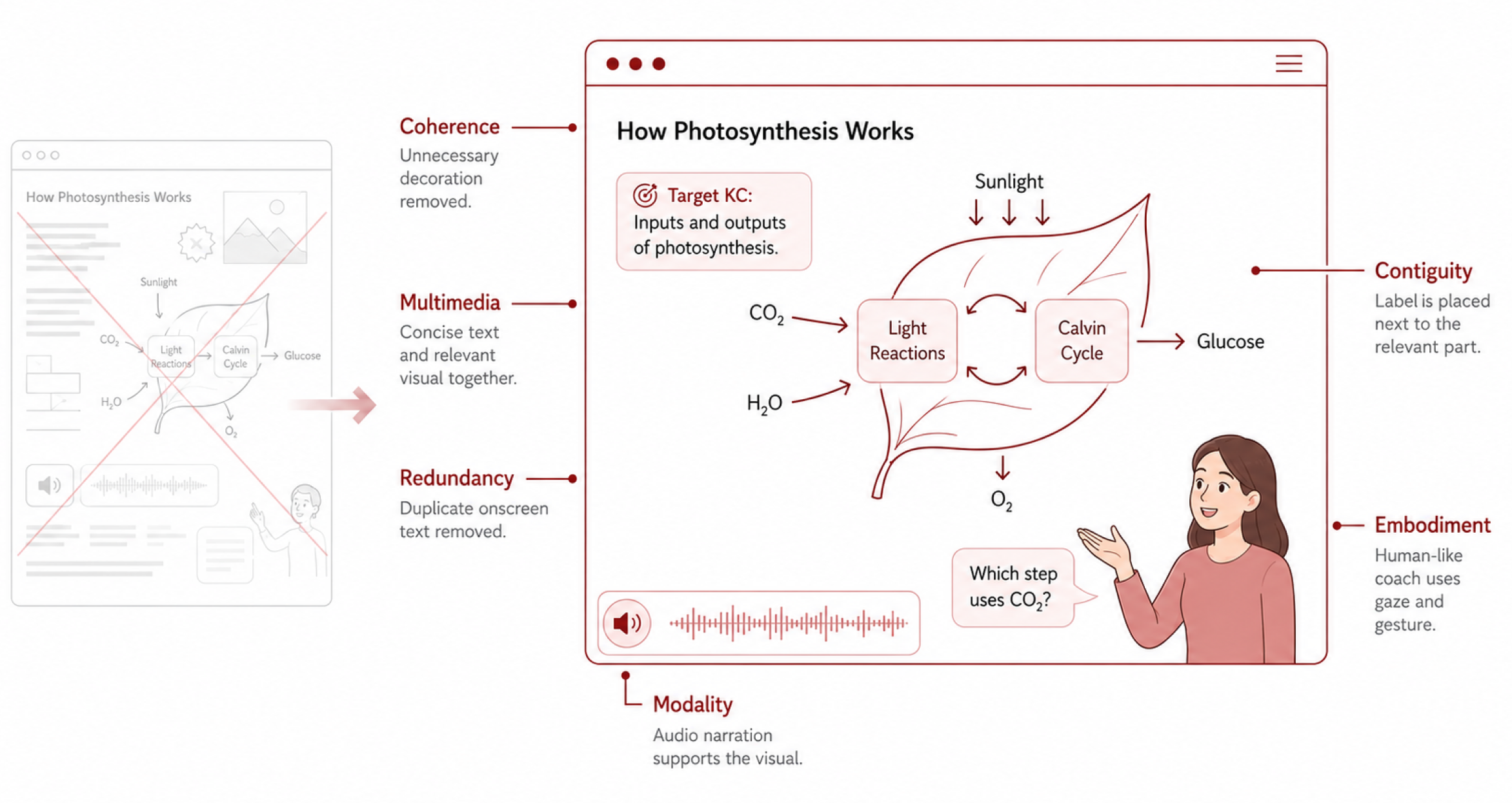
Online lessons can overwhelm learners when too much is introduced at once or when key concepts are assumed before learners are ready. Segmenting and pretraining are two powerful multimedia principles for reducing that overload and preparing learners for success.

In this course, you will learn how to apply segmenting and pretraining in online learning design. You will examine when to break material into manageable parts, when to introduce essential concepts in advance, and how these choices improve comprehension and reduce cognitive load.

Syllabus

Module 1: Segmenting and Pretraining
  • Recognize when the segmenting principle has been violated and when it has been applied well.
  • Recognize when the pretraining principle has been violated and when it has been applied well.
  • Describe how cognitive task analysis can be used to improve the application of the pretraining principle.
  • Describe how cognitive task analysis can be used to improve the application of the segmenting principle.

Meet the instructor

Dr. Ken Koedinger

Dr. Ken Koedinger

Professor
Carnegie Mellon University

Ken Koedinger is the Hillman University Professor of Computer Science at Carnegie Mellon University, with appointments in Human-Computer Interaction and Psychology. He holds an M.S. in Computer Science and a Ph.D. in Cognitive Psychology and has experience teaching in an urban high school. He has developed data-sharing and analytics infrastructures that support innovations in learning, including DataShop and LearnSphere, and has used them to improve learning as illustrated in his hundreds of publications. He directs LearnLab and co-founded Carnegie Learning in 1998, the first AI in Education company to bring intelligent tutoring technology into widespread use in schools. His PLUS project provides hybrid human-AI tutoring to middle school math students in schools around the country. He is a fellow of the Cognitive Science Society, the Association for Psychological Science, and the Association for Computing Machinery.