Core Course

Evidence-Based Backward Design for Online Learning

Beginner level

No prior experience required

Flexible schedule

4 weeks, 6 to 8 hours per week

Instructor feedback

Get guidance on your work

Verified certificate

Share on LinkedIn

*Proof of full-time student enrollment required. Acceptable forms of ID include a letter from your university’s registrar office or an unofficial transcript. Email your documents to learnlab-help@lists.andrew.cmu.edu.

What you will learn

  • Write clearer learning goals that guide online course design decisions.
  • Align assessments and instructional methods with intended learning outcomes.
  • Apply backward design principles in a way that is grounded in evidence from the learning sciences.
  • Plan iterative improvements to online learning experiences based on alignment and learner evidence.

Course description

Designing online learning effectively requires more than writing goals and choosing activities. Strong design depends on aligning learning outcomes, assessments, and instructional methods so that each decision supports the others and the course can improve over time.

In this course, you will learn how to use backward design in an evidence-based way for online learning. You will connect goals to assessment and instruction, apply learning engineering principles to design decisions, and build a stronger process for creating and iterating on coherent learning experiences.

Syllabus

Module 1: Determining instructional goals; KLI KCs; Blooms taxonomy
  • Explain backward design and the interrelationships between goals, assessment, and instruction.
  • Map elements of Bloom’s taxonomy to examples.
  • Categorize knowledge components along four dimensions.
  • Explain differences between KLI’s Knowledge Components, Learning Events, Instructional Events, Assessment Events.
  • Identify key hypotheses of the KLI framework.
Module 2: Refining Goals and Introduction to Designing Assessments
  • Evaluate and improve goals using KLI, Bloom’s taxonomy, and ABCD.
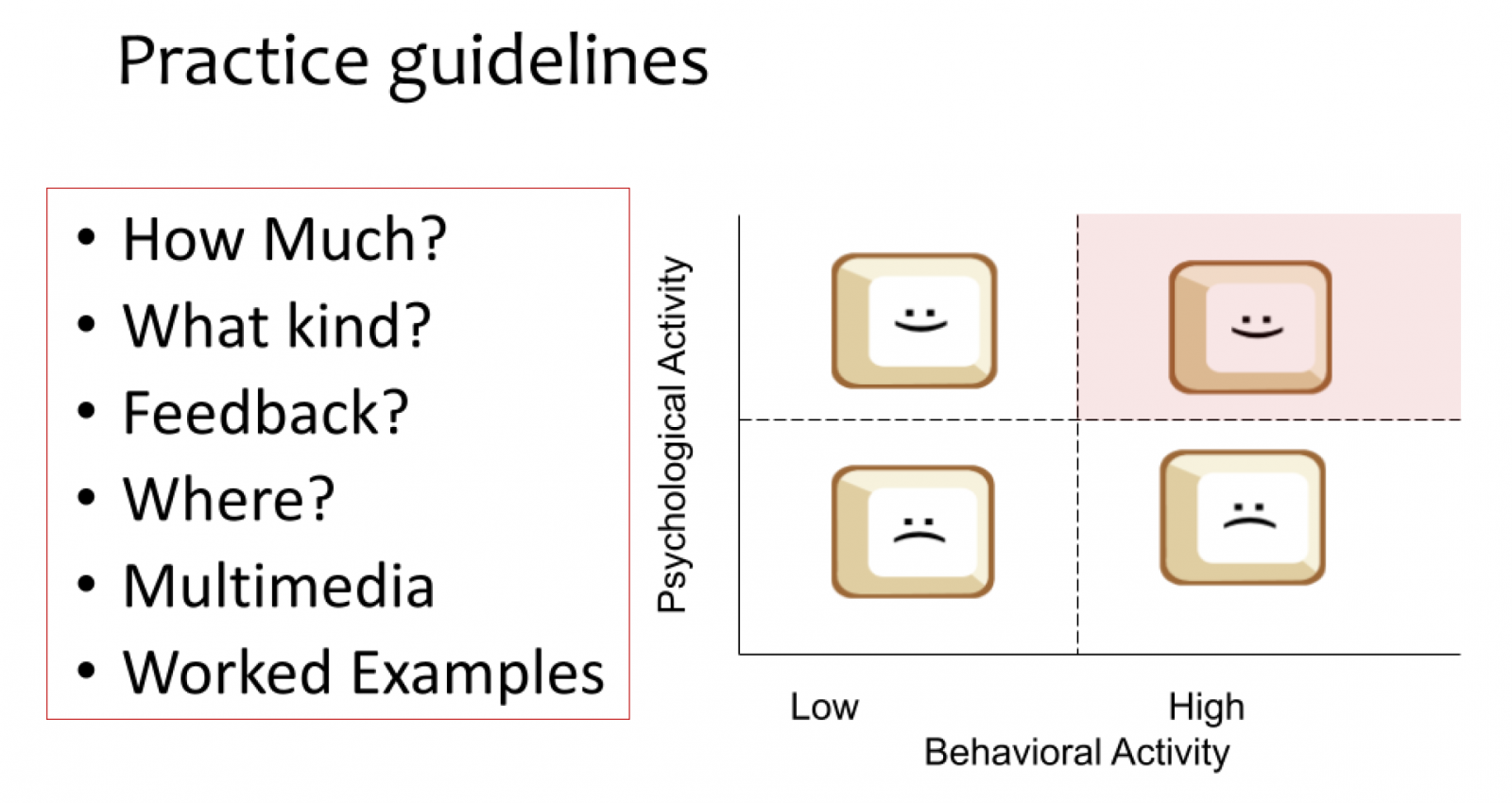
  • Apply evidence-based practice.
  • Explain how KLI and Bloom’s taxonomy fit in the E-Learning Big Picture?
  • Compare the purpose of formative and summative assessments.
  • Recognize the value and limitations of self-assessment.
Module 3: Why data toward goal setting improves design & Contextual Inquiry principles
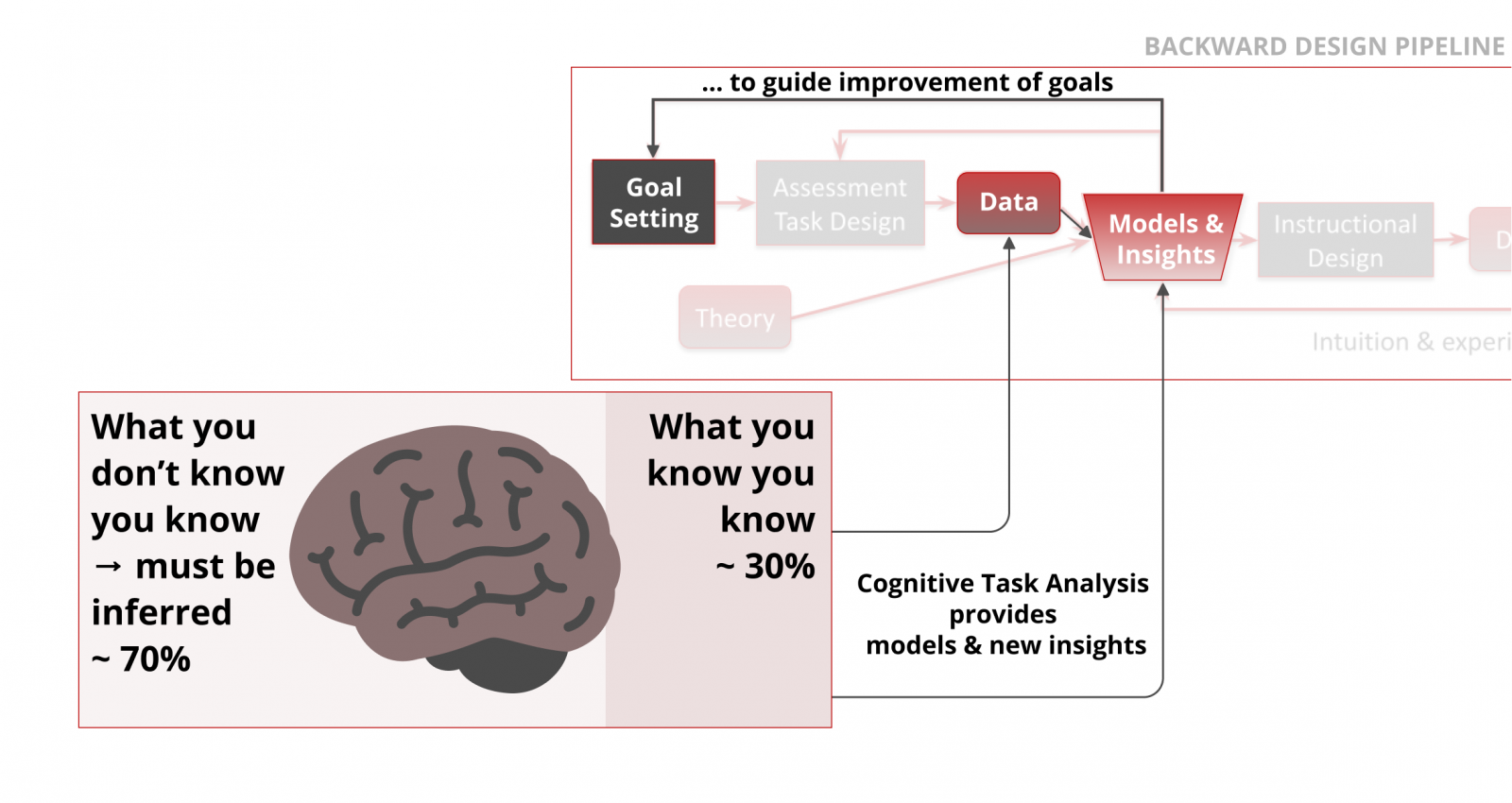
  • Explain why knowledge goals must be inferred from models of data.
  • Explain why “if-then” production rules are a good way to express the output (model & insights) of a Cognitive Task Analysis.
  • Explain and exemplify how Cognitive Task Analysis can be used to identify learning goals.
  • Explain why the four Contextual Inquiry Principles principles aid goal specification.
Module 4: Online assessment design and implementation
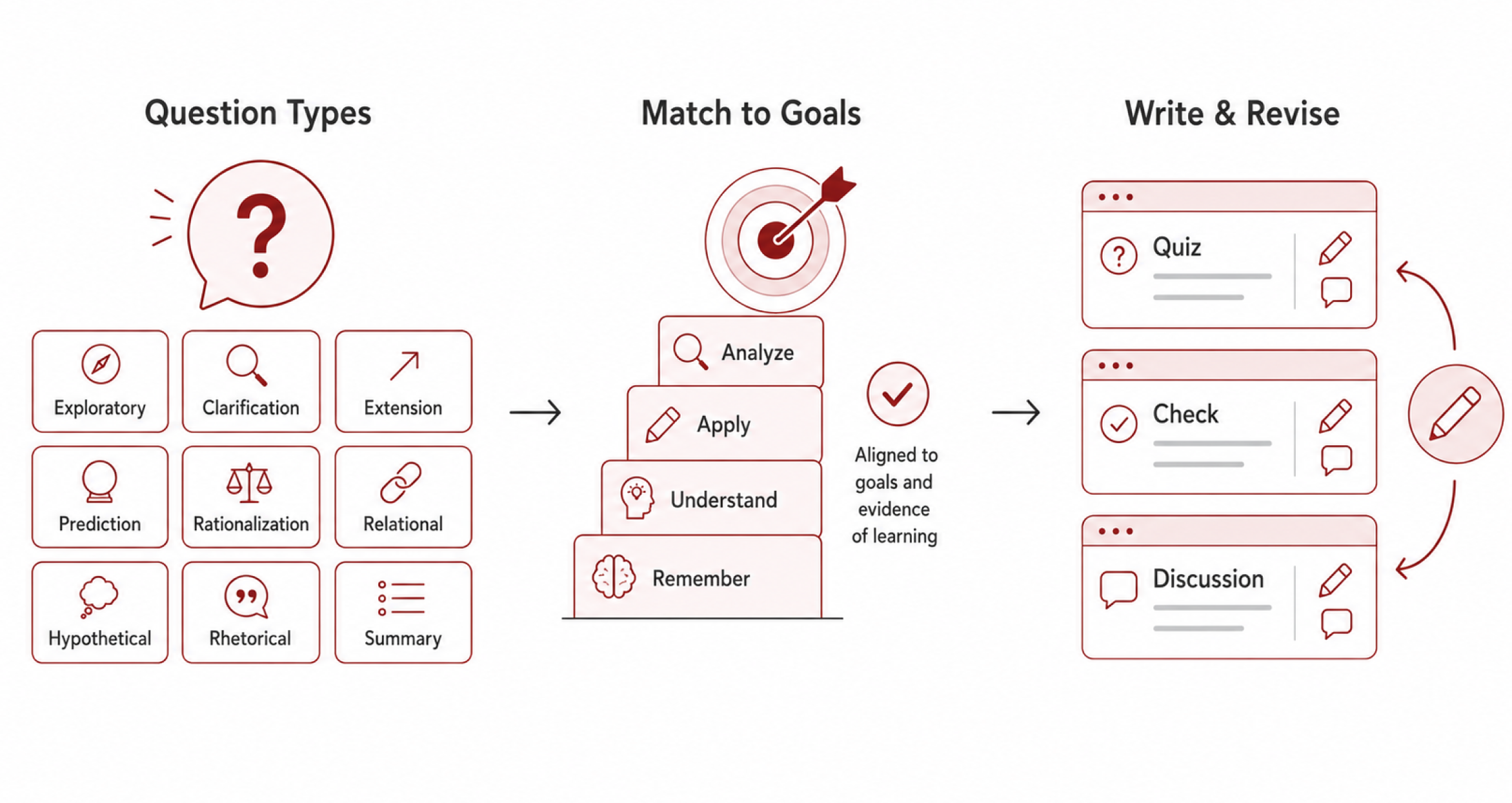
  • Evaluate and modify assessment questions based on KLI and Bloom’s taxonomy.
  • Recognize the variety of assessment authoring tools and salient features (good and not-so-good) of a few.
  • Implement well-designed assessments online using some assessment authoring tool.
Module 5: Course Project or Final Exam

At the end of the course, you’ll have an opportunity to do a little project where you design your own e-learning module. That will provide you with a nice experience to apply the fundamentals you will learn in the modules to a larger, more authentic context. It will be graded by the instructor and you will receive personalized feedback along with a sample solution.

You will also have the option to take a final exam with 20 questions. The exam can be taken multiple times, and each attempt draws new questions randomly from a pool of questions.

You may also complete both the course project and the final exam. The higher of the two scores will count toward the certificate.

Meet the instructor

Dr. Ken Koedinger

Dr. Ken Koedinger

Professor
Carnegie Mellon University

Ken Koedinger is the Hillman University Professor of Computer Science at Carnegie Mellon University, with appointments in Human-Computer Interaction and Psychology. He holds an M.S. in Computer Science and a Ph.D. in Cognitive Psychology and has experience teaching in an urban high school. He has developed data-sharing and analytics infrastructures that support innovations in learning, including DataShop and LearnSphere, and has used them to improve learning as illustrated in his hundreds of publications. He directs LearnLab and co-founded Carnegie Learning in 1998, the first AI in Education company to bring intelligent tutoring technology into widespread use in schools. His PLUS project provides hybrid human-AI tutoring to middle school math students in schools around the country. He is a fellow of the Cognitive Science Society, the Association for Psychological Science, and the Association for Computing Machinery.