Deep Dive Course

Predictive Modeling and Knowledge Tracing for Adaptive Learning

Intermediate level

No prior experience required

Flexible schedule

4 weeks, 6 to 8 hours per week

Instructor feedback

Get guidance on your work

Verified certificate

Share on LinkedIn

*Proof of full-time student enrollment required. Acceptable forms of ID include a letter from your university’s registrar office or an unofficial transcript. Email your documents to learnlab-help@lists.andrew.cmu.edu.

What you will learn

  • Explain the role of predictive modeling and knowledge tracing in adaptive learning systems.
  • Build models that estimate learner knowledge and forecast future performance.
  • Interpret learner-model outputs to support adaptive instructional decisions.
  • Compare modeling approaches in terms of fit, usefulness, and design implications.

Course description

Adaptive learning depends on more than static content sequencing. It requires models that estimate learner knowledge, predict future performance, and support timely instructional decisions. Predictive modeling and knowledge tracing are core methods for turning learning data into adaptive action.

In this course, you will learn how to build predictive models and use knowledge tracing approaches to model learner progress over time. You will examine how these methods support adaptive systems, what kinds of educational data they require, and how to interpret their outputs for design, intervention, and product improvement.

Syllabus

Module 1: Item Response Theory
  • Explain the fundamentals of Item Response Theory and how it differs from other assessment and modeling approaches.
  • Define and interpret the main parameters in Item Response Theory: Θ (latent trait estimate), a (item discrimination/sensitivity), b (item difficulty/location), and c (guessing).
  • Apply Item Response Theory in educational data mining and analytics.
  • Evaluate and design assessments using Item Response Theory.
Module 2: Feature Engineering
  • Explain the concept and purpose of feature engineering, and apply it to enhance a model’s predictive power.
  • Select the right feature distillation technique for a given context.
  • Evaluate the effectiveness of newly engineered features on model performance.
  • Apply strategies to avoid the risks of overfitting through excessive feature engineering.
  • Apply feature engineering approaches specific to educational data.
Module 3: Mastery Modeling and Bayesian Knowledge Tracing
  • Define cognitive mastery and explain where it fits on the adaptivity grid.
  • Explain how the effectiveness of mastery learning has been empirically tested.
  • Describe the goal of Bayesian Knowledge Tracing and its basic assumptions.
  • Define learning parameters p(L0) and p(T) and performance parameters p(S) and p(G).
  • Predict student performance using BKT and explain how correct and incorrect opportunities change estimates of mastery.
  • Apply data-driven tuning of cognitive mastery models and explain how mastery-based systems can contribute to wheel spinning.
Module 4: Knowledge Component Modeling
  • Define knowledge component modeling and describe its main goals.
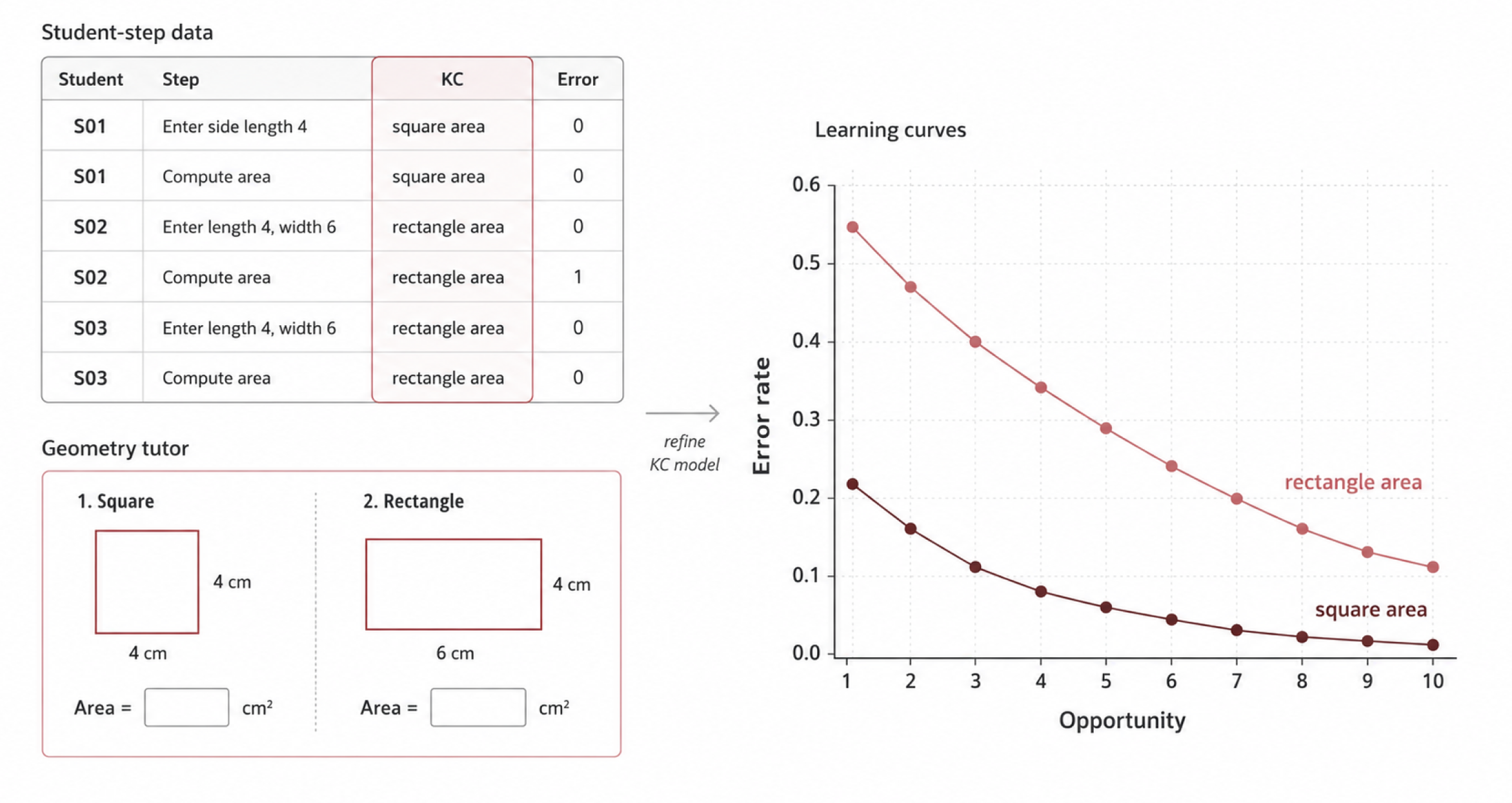
  • Explain how data is aggregated to produce a learning curve.
  • Recall the two key elements of a KC model and compare implementation approaches such as rule-based cognitive models, behavior graphs, and Q matrices.
  • Describe data-driven KC model revision and recognize when it is necessary to split, merge, or add knowledge components.
  • Evaluate a KC model with Additive Factors Model (AFM), including its purpose, high-level calculation, assumptions, and limitations.
Module 5: Learning Factors Analysis
  • Explain the role of cognitive task analysis in scaling instructional impact and generating a cognitive model candidate.
  • Describe how a Q matrix would be updated with a new cognitive model candidate.
  • Describe the Learning Factors Analysis (LFA) search algorithm at a high level.
  • Interpret and generalize the cognitive process represented in a candidate model.
  • Describe potential ways to redesign an intelligent tutoring system based on a new cognitive model.
Module 6: Course Project or Final Exam

At the end of the course, you’ll have an opportunity to do a little project where you will refine a system’s KC model so it better aligns with student learning. That will provide you with a nice experience to apply the fundamentals you will learn in the modules to a larger, more authentic context. It will be graded by the instructor and you will receive personalized feedback along with a sample solution.

You will also have the option to take a final exam with 20 questions. The exam can be taken multiple times, and each attempt draws new questions randomly from a pool of questions.

You may also complete both the course project and the final exam. The higher of the two scores will count toward the certificate.


Meet the instructor

Dr. Vincent Aleven

Dr. Vincent Aleven

Professor
Carnegie Mellon University

Vincent Aleven’s research aims to advance the science of how people interact and learn with adaptive, AI-based learning technologies, and to advance the design and engineering of these technologies. Practically, he aims to help realize the smart classroom through strong synergy among learners, those who facilitate learning such as teachers, instructors, peers, tutors, and parents, and novel AI applications. In this context, he is excited to help a new generation of scientists and professionals develop interest and skill in research and development.
Dr. Paulo Carvalho

Dr. Paulo Carvalho

Assistant Professor
Carnegie Mellon University

Paulo Carvalho is an Assistant Professor in the Human-Computer Interaction Institute at Carnegie Mellon University. His research explores how AI can revolutionize learning by creating engaging, practice-first environments. He uses data analytics and computational modeling to understand student learning, motivation, and interest and to develop precise models that inform better learning experiences. He is currently investigating how generative AI can empower these practice-focused approaches, boost engagement, and free teachers to provide personalized support. His research is funded by the National Science Foundation, IES, Schmidt Futures, the Walton Foundation, and Google.
Dr. John Stamper

Dr. John Stamper

Associate Professor & MSLE Program Director
Carnegie Mellon University

John Stamper is a faculty member in the Human-Computer Interaction Institute at Carnegie Mellon University in Pittsburgh, Pennsylvania. He is the Director of the Master of Science in Learning Engineering (MSLE) degree program and the Technical Director of the DataShop.