
Skip to content

From Signals to Support: Detecting and Responding to Motivation

Learn how to track, interpret, and ethically respond to motivational signals so learners stay engaged and supported.

Start Any Time

Work on your pace and you will have instructors available to help you answer any questions.

Duration

Approximately 2 weeks, 6-8 hours/week

Fee

$500 Professional Rate
$200 Full-time Student Rate

*Proof of full time student enrollment required. Acceptable forms of id include a letter from your university’s registrar office or an unofficial transcript. Email your documents to learnlab-help@lists.andrew.cmu.edu

Certificate Course Description:

This course helps you move beyond clicks and completion rates to uncover the deeper signals of learner motivation. You will learn to analyze behavioral, cognitive, and affective data to distinguish true engagement from surface activity. Using real-world case studies, you will explore how to spot motivational dips, visualize learner trajectories, and design timely, empathy-driven interventions. Emphasis is placed on safeguarding learner autonomy, equity, and privacy when collecting and acting on motivational data. By the end, you will know how to track meaningful indicators, interpret them responsibly, and respond in ways that sustain commitment and trust across diverse learning contexts.

Module 1: Measuring and Interpreting Motivation
  • Analyze behavioral engagement data to identify meaningful motivation signals and distinguish them from surface-level behaviors
  • Analyze cognitive engagement patterns to identify meaningful indicators of learner thinking and distinguish them from passive or superficial activity
  • Interpret affective signals in learner behavior to assess emotional investment and distinguish them from neutral or ambiguous participation patterns
 
Module 2: Responding to Motivation Dips with Empathy and Ethics
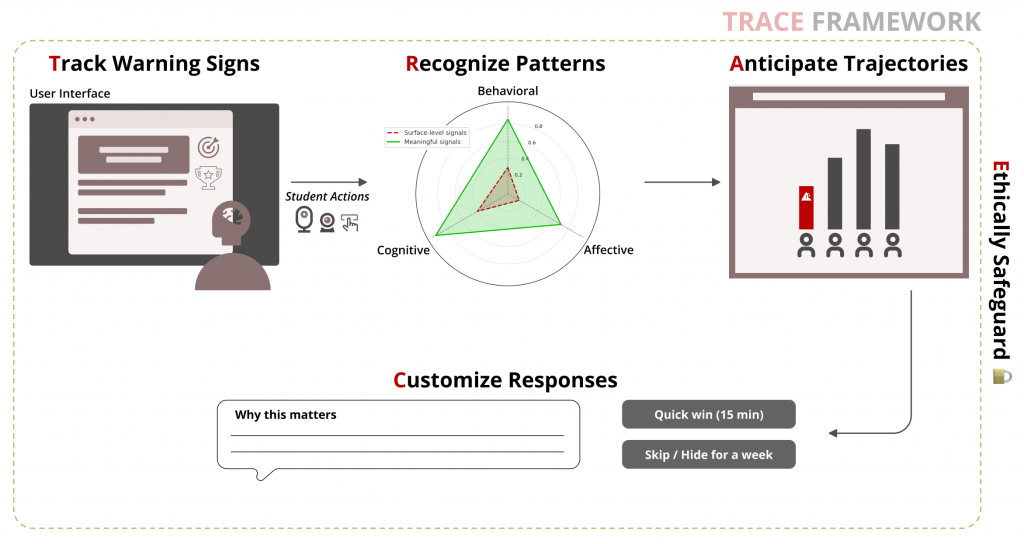
  • Identify and verify early warning signs of disengagement across behavioral, cognitive, and affective dimensions in user behavior data to confirm motivational risk.
  • Visualize and represent motivational dip patterns across behavioral, cognitive, and affective data to understand scope, recurrence, and group-level trends that inform decision-making.
  • Identify and differentiate common motivational trajectories using time-series and learner feedback data, verify whether dips are systemic or isolated, and anticipate when and where intervention is most effective.
  • Design and implement timely, culturally aware, and empathy-driven re-engagement strategies that restore learner autonomy, purpose, and motivation.
  • Apply ethical design principles to the collection, analysis, and intervention of motivational data, ensuring learner privacy, autonomy, and equity are protected.
 
 
Module 3: Course Project or Final Exam

At the end of the course, you’ll have an opportunity to do a little project where you can choose to work on topic of your choice. That will provide you with a nice experience to apply the fundamentals you will learn in the modules to a larger, more authentic, context getting feedback from experts.

You will have an alternative option to take a final exam where you will answer 30 questions. The exam can be taken multiple times and each time new questions are randomly selected from a pool of questions.

You are also free to do both the course project and the final exam, we will consider the one in which you score more for counting towards the certificate.

No prerequisites required, having some programming experience and finishing the prior course in series Designing for Motivation in EdTech is recommended.

Researchers, learning designers, educational data scientists, instructional designers, and students who want to learn about how to instrument data in their edtech and learning experiences to find out whether their learners are motivated. Anyone interested in edtech.

What you'll learn

This course will help you:

  • Measure and interpret motivation by analyzing behavioral, cognitive, and affective engagement data, distinguishing meaningful signals from surface-level activity.

  • Recognize and anticipate motivational patterns by identifying early warning signs of disengagement, visualizing dip trajectories, and differentiating systemic versus isolated risks.

  • Design empathetic and ethical responses to motivation dips by creating culturally aware, autonomy-supportive re-engagement strategies that safeguard learner privacy, equity, and trust.

Course Instructors

Dr. Amy Ogan

is an Associate Professor of Learning Sciences at Carnegie Mellon University. Dr. Ogan has a PhD in Human-Computer Interaction supported by a fellowship from the Institute of Education Sciences. Her main area of research is focused on ways to make learning experiences more engaging, effective, and enjoyable. She is also the Director of Learning Sciences for Innovators, which helps companies in Africa refine and scale edtech products using evidence-based methods that support engaging and effective learning experiences…

[Read More]

Certificate

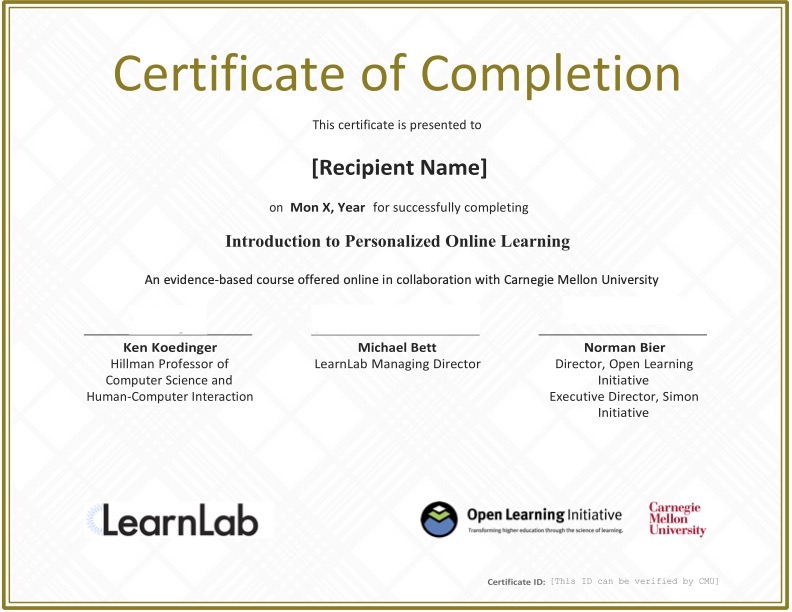
Upon successful completion of the program, participants will receive a verified digital certificate of completion from Carnegie Mellon University’s Open Learning Initiative.

In addition to the knowledge and immediately applicable frameworks you will gain by attending your selected courses, you will benefit from:

  • A digital, verified version of your Executive Certificate (Smart Certificate) you can add to your resume and LinkedIn
  • Networking with a global group of your peers and instructors for advancing your career

Register Now

Register and start taking the course in three steps:

1. Enter your name and email address.

Name

2. Create your account here to access our learning platform.

3. Register and access the course here.

Have questions? Our learning engineers are here to answer them at our monthly live AMA events! Join us at 4 PM EST on First Fridays, or 10 AM EST on Third Mondays. Registration required.